
Every big technology shift sends the bill before anyone sees the payoff. Railroads, fiber-optic cable and cloud data centers all asked investors to pay up years before the returns showed up.
Meta Platforms knows that pattern better than most companies. Wall Street punished the stock in 2022 for spending heavily on a metaverse that never arrived on schedule, and the company spent much of the next year rebuilding that trust.
That history is why every new artificial intelligence (AI) dollar Meta spends gets so much scrutiny. Investors want to know whether this bet will look like cloud computing or like virtual reality headsets.
The race has only gotten more expensive. Meta, Microsoft, Alphabet and Amazon have all poured record sums into data centers, and shareholders now want proof that the spending can turn into products people use.
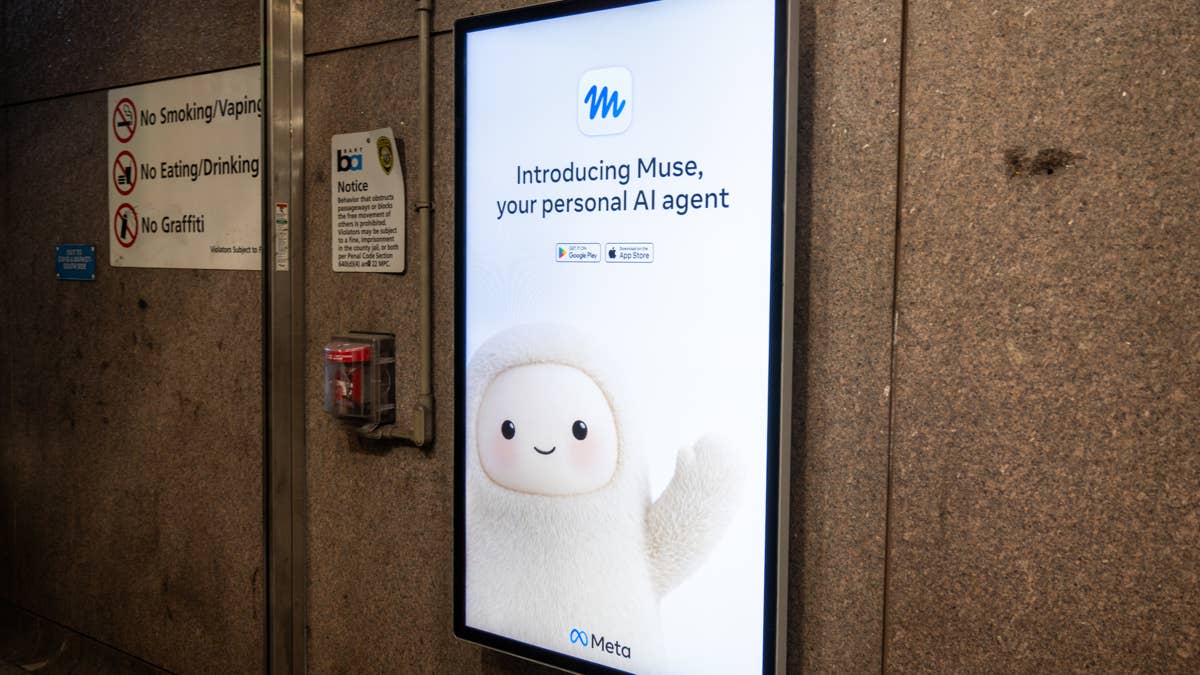
Meta’s first piece of evidence arrived in September. Its Muse personal agent, unveiled on Sept. 8, climbed to the top of Apple’s U.S. App Store, TheStreet reported.
On Monday, Oct. 12, Meta Platforms (META) gave its clearest answer yet. The company released Muse Wonder, its first frontier-class AI model, and CEO Mark Zuckerberg explained why he was willing to write a check of up to $200 billion before he knew it would work.
At the same time, early app data gave bulls something to point to. Jim Cramer called the stock a “monster long” after Sensor Tower figures showed Meta’s Muse app keeping users almost as well as ChatGPT.
Zuckerberg explains Meta’s $200 billion AI wager
Zuckerberg made his case on John Collison’s Cheeky Pint podcast, alongside Alexandr Wang, who runs Meta Superintelligence Labs.
More Artificial Intelligence:
- Bots playing fake AI songs siphoned $8 million from real artists
- AI Is Deciding What You Pay for Groceries — And It Knows You
- OpenAI CEO Sam Altman has a biblical-level warning about AI
At the end of last year, Meta was ready to “write this check for like, I don’t know, like $100 billion, $200 billion,” before seeing what the models could do, Zuckerberg said.
“Alex, are you sure this is going to work?” Zuckerberg recalled asking Wang. The running line inside the lab was that they hoped it would all work and be good, Wang said.
Zuckerberg then laid out why he thinks the downside is smaller than it looks.
“In order for it not to work out, it’s not just that we have to fail, AI overall has to fail,” Zuckerberg said.
Related: Mark Zuckerberg sends bold message to Meta investors after Muse
That line is the core of the bull case. Meta is arguing that the real risk is being shut out of the next computing platform, and that overspending is the cheaper mistake.
The costs are huge, though. Wang said training a frontier model now runs “tens of billions of dollars,” and the pair described a gigawatt-scale cluster as costing roughly $50 billion to $60 billion upfront and about $15 billion a year to operate.
Wonder’s pricing, access and memory features explained
Meta released two versions of the new model, TechCrunch reported. Muse Wonder is available to developers through the Meta Model API, while the higher-end Muse Wonder Full is limited to Muse Code subscribers.
Here is how the launch breaks down, according to TechCrunch:
- API price: $4 per million input tokens and $20 per million output tokens for Muse Wonder
- Access: Wonder Full is not offered through the API
- Signature feature: “active memory,” which lets the model keep and connect information a user shares over time
- Training site: Meta’s Prometheus data center in central Ohio
- Performance: Meta says its own testing puts Wonder in line with leading models from rival labs
The team worked to help the model “remember what’s important to you over days, weeks, months and beyond,” Meta research scientist Kavya Kopparapu said in a launch video.
Investors should note that the benchmark claims come from Meta’s own testing. Independent results will matter more over the next few weeks.
Jim Cramer’s ‘monster long’ call leans on app retention data
“Meta continues– I think it is a monster long but i know others are coming…,” Cramer wrote on social media, Benzinga reported.
The data behind his call came from Sensor Tower’s September figures, shared by Menlo Ventures partner Deedy Das, according to Benzinga:
- Day 1: Muse kept 73.3% of users, compared with 41.3% for ChatGPT
- Day 14: ChatGPT kept 26.8% and Muse kept 22.5%
- Other apps at day 14: Threads 21.2%, Google Maps 18.5%
I think the headline comparison misses the more revealing number. By my math, Muse held onto about 31% of its day-one users by day 14, while ChatGPT kept about 65% of its own.
That gap suggests Muse is winning curiosity faster than it is building habit. Meta can afford that for now, since billions of people already use its apps, but retention will decide whether Muse becomes a business.
Meta stock now hinges on turning users into revenue
Meta shares closed at $718.67 on Friday, Oct. 9, and were up 1.67% in premarket trading on Monday, Oct. 12, according to the Benzinga report.
The new models sit above Muse Spark, a lighter and faster model, in Meta’s lineup, TechCrunch reported. They are Meta’s first frontier release since Wang restructured its AI efforts in August 2025.
That gives Meta two ways to make money from the same technology. It can charge developers for API access and charge consumers for subscriptions, while also using the models to keep people inside Facebook, Instagram and WhatsApp.
The bull case now has three legs: a frontier model of its own, an app that people try in large numbers, and a CEO willing to spend through doubt. The bear case is just as clear, because the spending is enormous and paid subscriptions are still unproven at Meta’s scale.
The next real test comes when Meta reports quarterly results and shows how much of this spending is turning into revenue. Until then, Zuckerberg’s own line sets the stakes, since he has tied Meta’s AI fate to the fate of AI itself.
Related: Meta Muse gives AMD and Intel investors a reason to cheer